Storytelling as a tool for Social Science Practice
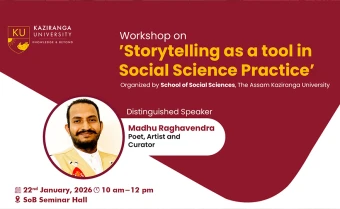
Event Name: Storytelling as a tool for Social Science Practice
Event Date: 22/1/26
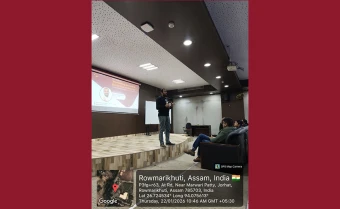
Event Location: SoB Seminar Hall
Organized By: School of Social Sciences, The Assam Kaziranga University
Category: Workshop
About the resource person: Madhu is a poet, artist, and curator, who has authored four books of poetry, Make Me Some Love to Eat, Stick No Bills, Being Non-essential, and Going Home. He was a poet-in-residence at the International Writing Program Fellowship, University of Iowa, and the Charles Wallace Writing Fellowship, University of Stirling. He collaborates with global artists to create cross disciplinary poetry experiences, and his poems have been set to classical music and contemporary dance in the United States, Finland and the Netherlands. He conducts poetry workshops for young adults, and uses poetry as a tool in development conversations. He has participated in PEN Emergency World Voices Congress of Writers at the United Nations Headquarters, New York. He curates the multidisciplinary Ajanta Ellora Arts Residency.
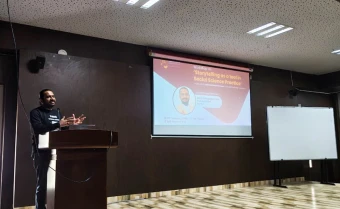
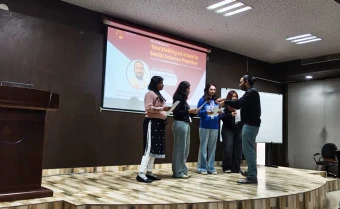
Summary of the event: The workshop explored how storytelling works and why it is important. Students learned that telling a story requires imagination, the use of metaphors, and a sense of performance. A storyteller must act as both a "doer" and an "observer," drawing from their own lived experiences to create narratives.
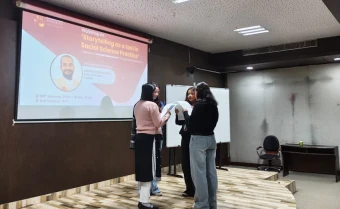
The session highlighted that stories are not just for entertainment. They are essential tools for connecting with people, conducting academic research, and shaping public policies and political will. The facilitator also explained the important difference between empathy and sympathy, and discussed how poems can reflect social development. The facilitator conducted activities like group reading exercises and expressive relays to engage with the students’ emotions. The workshop concluded with an experience sharing activity, allowing students to practice collaboration and apply what they learned.